
From one agent to a network: what happens when AI runs your processes?
A chat assistant in your ERP that answers questions and summarises documents is useful. Most organisations are at this level today — whether they run Exact, AFAS, Microsoft Dynamics 365 Business Central or another ERP — and the first reactions are positive. People save time, registration becomes more consistent, data is finally findable.
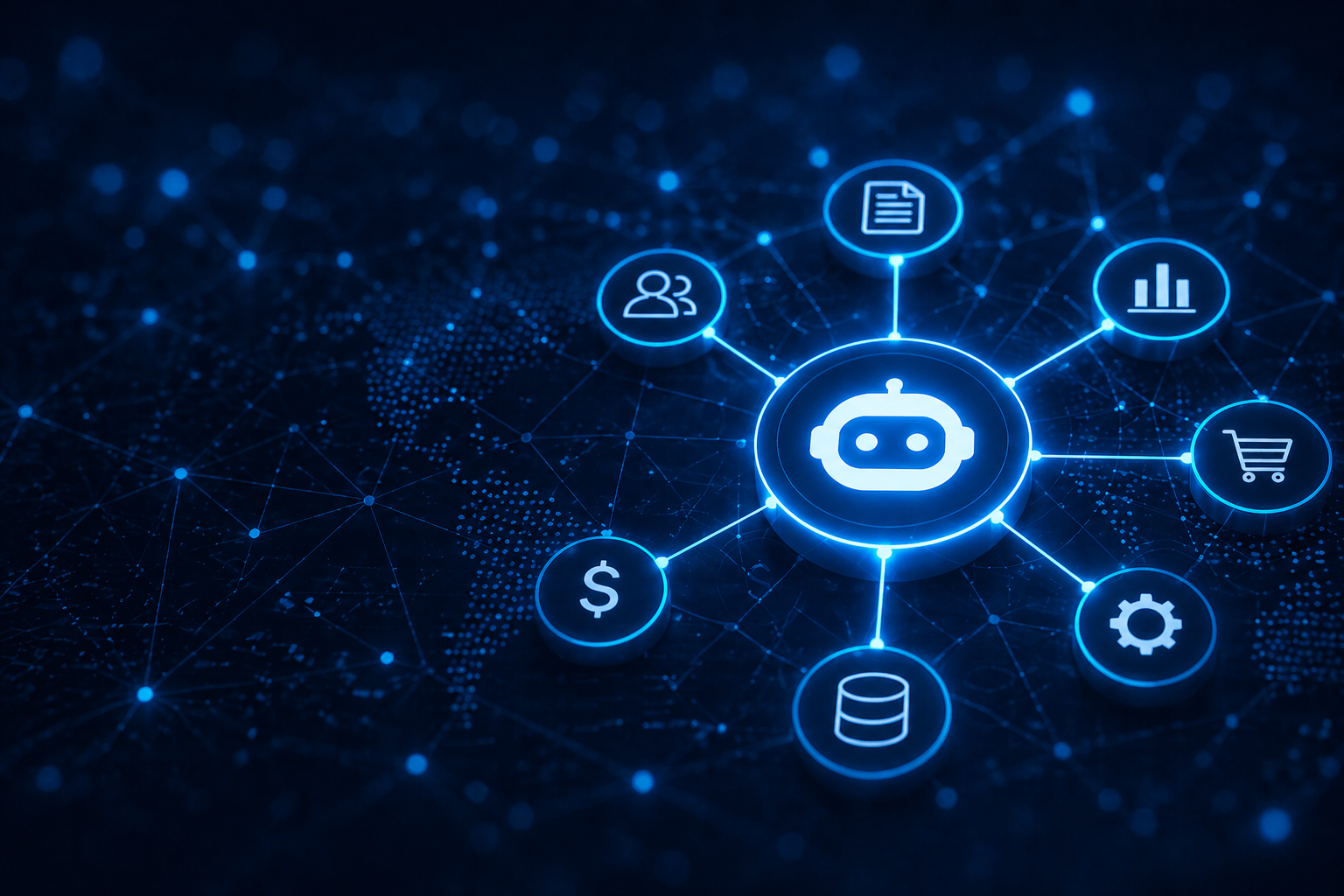
But this is the preliminary step. The real shift — the one you'll be dealing with as a director or manager within a year, whether you approach it strategically or not — is that you're not working with one agent, but with a network of agents that together execute entire processes. AI orchestration.
Where one agent stops
Take a quote process. One agent can read an incoming request, match the customer in your ERP, pull up historical orders and prepare a draft quote. Good. But then it stops. Someone has to review the quote, send it to purchasing for margin check,dispatch it on approval, follow up after a week, convert it into an order upon agreement, and synchronise that order with production or inventory.
In today's situation, the entire chain after step one is manual work again. What's coming now: for each step there's a specialised agent, and there's an orchestration layer that decides who does what — and when a human steps in.
What multi-agents looks like in practice
A purchasing agent checks margins against your procurement conditions in Exact. A sales agent composes a personalised email based on the customer history in AFAS. A logistics agent asks your WMS whether the delivery time is feasible. A finance agent validates in Business Central whether the credit limit allows it.
This isn't science fiction. It's a series of small, specific agents that can each do one task —retrieve, compare, create, signal — and together are steered by an orchestrator. The orchestrator knows which agent's turn it is and when, where data flows from one to the other, and — crucially — at which moments a human must decide.
Human in the loop, always
This is where many AI stories derail. "Full automation" sounds impressive but doesn't work in a real company. Not because the technology can't handle it, but because decisions have consequences: a wrongly sent quote costs money, a flawed credit note costs trust, an error in an order costs inventory.
In a well-designed multi-agent process, it's deliberately set out where humans decide. Not everywhere — then you've gained nothing. But at the points where it matters: final dispatch to the customer, financial commitments above a threshold,deviations from standard conditions. The agents do the groundwork, the human signs off.
What this changes for you
As a director of a mid-sized enterprise, this is where the real question sits: not "which AI tool do we buy", but "which processes in my organisation are so repetitive that an agent network can run them, and where do I maintain human judgement?"
For IT and operations managers, it means: stop thinking in terms of one big solution. Start with one agent that proves it works, add a second that takes over the next step in the process, and build a chain that expands incrementally. Every agent must be separately controllable, separately replaceable and separately measurable.
Where this falls apart
On one point: no one overseeing the integrated process. You can buy AI agents as components. A working network of agents is a design question — and that's about more than technology.
Curious how an agent network would look for your processes? We help organisations move step by step from one assistant to a working process network, always with humans in control.